Sardinia's Blue Zones: The Slow Travel Secret of the World's Longest-Lived Villages
Picture a mountain village in the heart of Sardinia. An elderly man makes his way up a steep stone lane at an unhurried pace, a loaf of bread tucked under his arm. He stops to greet a neighbor, then another, then settles onto a bench in the afternoon sun, because there is nowhere he needs to rush off to. He is well into his nineties. In this part of the world, that is not especially remarkable.
Welcome to Sardinia's Blue Zone, one of the very few places on Earth where living to 100 is woven into ordinary daily life. And this October, the island made international headlines again, when researchers named a small Sardinian village as a candidate for the world's newest Blue Zone.
For travelers, these mountain villages offer something far rarer than a postcard view. They offer a glimpse of a completely different way of living, and an invitation to live that way yourself, even if only for a week. This is the 99% of Italy most visitors never see, and it is one of our favorite places to send travelers who want to slow down.
What Exactly Is a Blue Zone?
A Blue Zone is a place where people live measurably longer than almost anywhere else, with an unusually high share of residents reaching their nineties and beyond, often in good health.
The name has a charmingly low-tech origin. In the late 1990s, Italian physician Gianni Pes of the University of Sassari and Belgian demographer Michel Poulain were mapping longevity across Sardinia. Pes marked the villages with the highest concentrations of centenarians in blue ink, and those blue marks clustered tightly in the island's mountainous interior. The name stuck.
National Geographic Fellow Dan Buettner later brought the idea to a worldwide audience. Today, five regions are widely recognized as Blue Zones: Sardinia, Italy; Okinawa, Japan; Ikaria, Greece; the Nicoya Peninsula, Costa Rica; and Loma Linda, California. Sardinia was the first.
What separates a true Blue Zone from a local legend is the paperwork. Researchers verify every age against independent records, including birth certificates, baptismal registers, and death records, before a village earns the name.
And the common threads across all of these places are strikingly simple:
Natural movement built into the day, not scheduled exercise
A mostly plant-based diet centered on beans, vegetables, and whole grains
Strong family bonds and daily social connection
A sense of purpose and belonging, often rooted in faith and community
A slower, steadier rhythm of life
None of it comes from a gym membership, a supplement aisle, or a wellness app. It comes from the way these communities have always lived.
Sardinia's Original Blue Zone: Shepherd Country
Sardinia's Blue Zone sits far from the turquoise coves most visitors picture when they think of the island. It lies in the rugged interior, in the regions of Ogliastra and Barbagia, in the mountain villages surrounding the Gennargentu massif and its highest peak, Punta La Marmora. The original zone covered 14 villages, with names like Arzana, Baunei, Seulo, Talana, Urzulei, and Villagrande Strisaili.
This is shepherd country. For generations, life here meant long days on foot across steep terrain, tending flocks and working small family plots. What first caught researchers' attention was not just how long people lived, but who was living longest. Almost everywhere in the world, women outlive men by several years. In Sardinia's Blue Zone, the men keep pace. In Villagrande Strisaili, the number of male and female centenarians is so close that men have edged slightly ahead.
The village of Seulo, home to fewer than 1,000 people, recorded 20 centenarians between 1996 and 2016, a figure locals proudly describe as a world record. Nearby Perdasdefogu has a Guinness record of its own: in 2014, nine living siblings of the Melis family reached a combined age of more than 800 years. In both villages, black-and-white portraits of local centenarians hang along the streets, a public celebration of a long life well lived.
This is not a fading phenomenon, either. A 2023 reassessment found that the Blue Zone has actually expanded beyond its original borders, and that someone born in the redefined zone still has roughly twice the chance of reaching 100 as someone born elsewhere in Sardinia.
Bolotana: Sardinia's Newest Longevity Story
Just this month, a small village called Bolotana made international news. In a study published in the journal Frontiers in Aging, an international research team that included Gianni Pes and Dan Buettner identified Bolotana, a hillside community roughly 68 miles from the original Blue Zone, as a candidate for a brand-new Blue Zone.
As Fox News reported, a 2024 snapshot counted 10 centenarians among the village's 2,262 residents. That is roughly ten times the Sardinian average and eleven times the U.S. average.
What makes Bolotana unusual is who is living longest. In the original Blue Zone, the men stand out. In Bolotana, it is the women. The study estimated that a 70-year-old woman in Bolotana has close to a 14 percent chance of reaching 100, compared with roughly 3.5 percent for women across Italy.
Buettner points to three everyday habits shared by the village's longest-lived residents:
They move all day without thinking about it. Bolotana's streets are steep, and residents rarely drive within town. They walk to the shops, to the café, to work, and to their friends' homes.
They eat mostly plants. Beans, vegetables, wheat, olives, and olive oil from ancient groves are the traditional staples. Lunch, the main meal, is very often a bean-rich minestrone made with whatever is in season. Meat traditionally appeared only about five times a month, usually as a celebration.
They stay deeply connected. Shared meals, church, baking bread together, and simply sitting down with a friend to talk about the day are part of the fabric of village life.
Buettner also suggested that because Bolotana is part agricultural and part pastoral, more men are home to share household responsibilities, which may lighten the stress carried by women. The researchers are careful to say that the study does not prove these habits cause longer lives, and Bolotana remains a candidate rather than a confirmed Blue Zone. But as Buettner told Fox News, these residents are not deliberately chasing a long life: "It is the product of their environment."
That one sentence may be the most important thing a traveler can understand about this island.
How Life Is Different in a Blue Zone
Spend a few days in these mountains, and you begin to notice what is missing. There is no rush hour in the village center. There is no drive-thru, no takeout coffee, no one eating lunch at a desk. The day is organized around the midday meal, eaten slowly and almost always with family. The afternoon softens into stillness. Evening belongs to the piazza, the bar, and conversation that can stretch for hours.
The food tells the same story. You will find pane carasau, the paper-thin, crackling flatbread shepherds once carried into the hills for weeks at a time. You will find pecorino made from the milk of local sheep, hearty bean and vegetable soups, and culurgiones, the hand-pleated stuffed pasta that is a point of pride in Ogliastra. You will be poured a modest glass of Cannonau, the island's deep, rustic red wine. None of it is fussy. All of it is local.
Elders are not set aside here. They live with or near their families, they help raise grandchildren, and they remain woven into the daily life of the village. Many still tend a garden, a vineyard, or a few animals well into old age. Purpose is not something they had to go looking for after retirement. It never left.
IWB Tip: Always order the minestrone. In Sardinia's Blue Zone villages, a humble bowl of bean and vegetable soup is not a side dish. It is the heart of the daily meal, and it may be the most meaningful thing you eat on the entire island.
How Traveling Here Is Different
Most visitors to Sardinia never see this side of the island. They fly into Olbia, head to the Costa Smeralda, and spend their days on some of the most beautiful beaches in the Mediterranean. That is a wonderful trip. But it is only part of the story. Traveling into the Blue Zone asks for a different mindset, and here is what to expect:
There is no ticket and no front gate. The Blue Zone is not an attraction. It is a scattering of living, working villages. There is no visitor center to check off. The experience is the village itself.
Lodging is small and personal. Think family-run agriturismi, guesthouses, and simple country inns rather than large resorts. What you give up in amenities, you gain in warmth and authenticity.
You will need reliable transportation. These villages sit along winding mountain roads with limited public transit. A private driver or a confident behind-the-wheel traveler is essential.
English is less common. In the interior, daily life happens in Italian and Sardinian. A knowledgeable local guide does far more than translate. They open doors that would otherwise stay closed.
Respect comes first. The centenarians of Sardinia are people, not sights. Greet them warmly, ask before taking photos, and spend your money with local bakers, cheesemakers, and winemakers.
Why Sardinia's Blue Zones Are Made for Slow Travel
Slow travel is not about doing less. It is about doing things the way the people who live there do them: fewer places, deeper connections, and time to let a destination change you a little.
Sardinia's Blue Zone is slow travel in its purest form, because the local way of life is already built around the very things slow travelers are looking for. Every habit that helps these villagers thrive translates beautifully into a better trip:
Walk instead of drive. Leave the car parked and explore each village on foot, the way residents do every day. The steep lanes, hidden courtyards, and mountain views reveal themselves slowly.
Make lunch the main event. Book a long, unhurried midday meal at a family table instead of squeezing in a quick bite between sights.
Stay longer in fewer places. Our planning rule of thumb is to divide your days by four to find the right number of bases. One week in Sardinia means two bases, not five hotels.
Learn by doing. Make pasta, bake bread, or tend a garden alongside a local family. These are the experiences our travelers remember long after the photos fade.
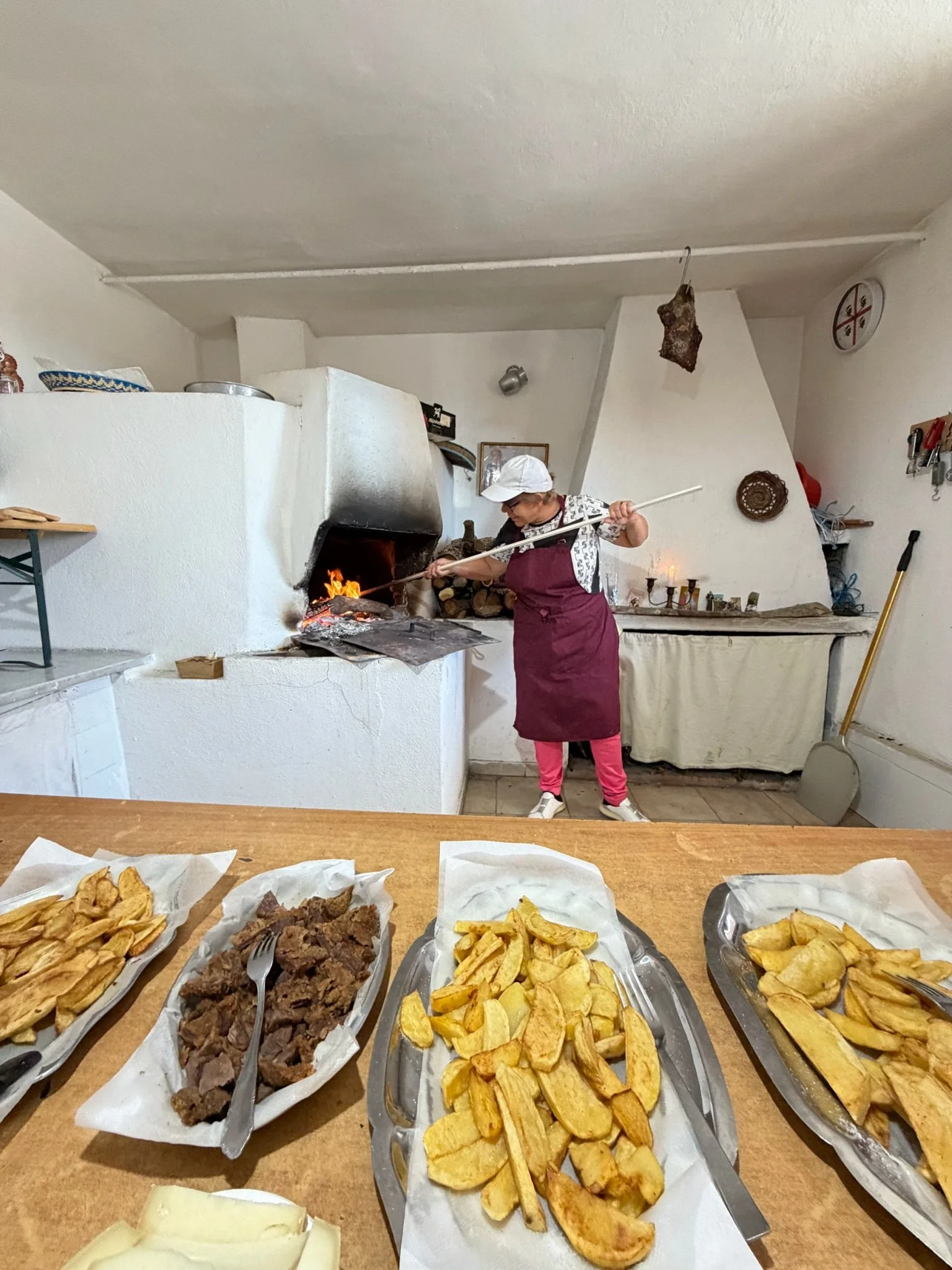
We have seen this firsthand. On one of our own Sardinia days, we traveled from Alghero to Montresta, a tiny village of roughly 300 people, and spent the day in the kitchen of a local woman named Leonarda, shaping traditional pastas and local bread before sitting down to lunch at her table. Montresta is not part of the official Blue Zone, but that day captured everything the Blue Zone way of life is about: unhurried, generous, and rooted in family and food. In Cagliari, a morning at the fish market with a local chef, followed by hands-on pasta making and a multi-course meal at her restaurant, delivered the same feeling. That is the kind of day we build into every Sardinia itinerary we design.
IWB Tip: Pair the coast with the mountains. With a week on the island, spend part of it near the sea and part of it in or near the interior. You get the famous Sardinian water and the Sardinia that most visitors never find, without ever feeling rushed.
When to Go
Late spring and early fall are ideal for a Blue Zone journey. May and June bring wildflowers to the hills and comfortable temperatures for walking. September and October offer golden light, harvest season, and far fewer visitors.
October and early November are especially lovely, with gentle weather and smaller crowds. Just know that many restaurants, agriturismi, and seasonal businesses begin to close or slow down as mid-November approaches, so plan accordingly. August is the busiest month on the island, particularly along the coast, and it is the month we would steer slow travelers away from.
Our Honest Take
A Blue Zone is not a destination you check off a list. You cannot buy the secret to living to 100 in a gift shop, and you will not discover it in a single afternoon.
But spend a week in Sardinia moving at the pace of its villages, and something shifts. You walk more. You linger at the table. You talk with the people around you instead of scrolling past them. You begin to understand that a long life here is not the result of discipline or deprivation. It is the natural product of good food, steep streets, close families, and time that is never rushed.
That is the 1% of travelers who see the real Sardinia. And it is exactly the kind of trip we love to create.
Ready to Experience Sardinia Slowly?
At Italy With Bella, we design fully custom, private itineraries across all 20 Italian regions, including the parts of Sardinia that never make the brochures. We know the villages, the families, and the timing that turn a beach vacation into something far more meaningful.