Experience the 2026 Winter Olympics in Italy: A Journey Through Milan, Cortina, and the Dolomites
An Italian Winter Dream
In February 2026, the world will turn its gaze toward Italy as the Winter Olympics return home to two of its most iconic regions — Milan and Cortina d’Ampezzo. Known collectively as Milano Cortina 2026, these Games will be unlike any before: a celebration of sport intertwined with Italian culture, fashion, alpine beauty, and centuries of history.
Imagine sipping espresso in a Milanese café before an ice-skating final, or gliding through the snow-dusted Dolomites after watching the world’s best downhill skiers. The 2026 Winter Olympics will not just be an athletic spectacle — they’ll be an invitation to experience Italy at its most elegant and exhilarating. That said, as with any major international event, travelers should prepare for large crowds, sold-out accommodations, and occasional logistical hiccups. The reward is immense, but so is the demand for Italy’s signature hospitality during this time.
When and Where: Key Dates & Locations
The XXV Olympic Winter Games will take place from February 6 to February 22, 2026, followed by the Paralympic Winter Games from March 6 to March 15, 2026.
Unlike previous Games concentrated in one city, Milano Cortina 2026 will unfold across five distinct Italian regions — each offering its own flavor of beauty, culture, and adventure. This multi-region format also means travel between sites can be time-consuming and sometimes unpredictable, especially in mountain areas affected by winter weather. A bit of patience, and flexibility, goes a long way.
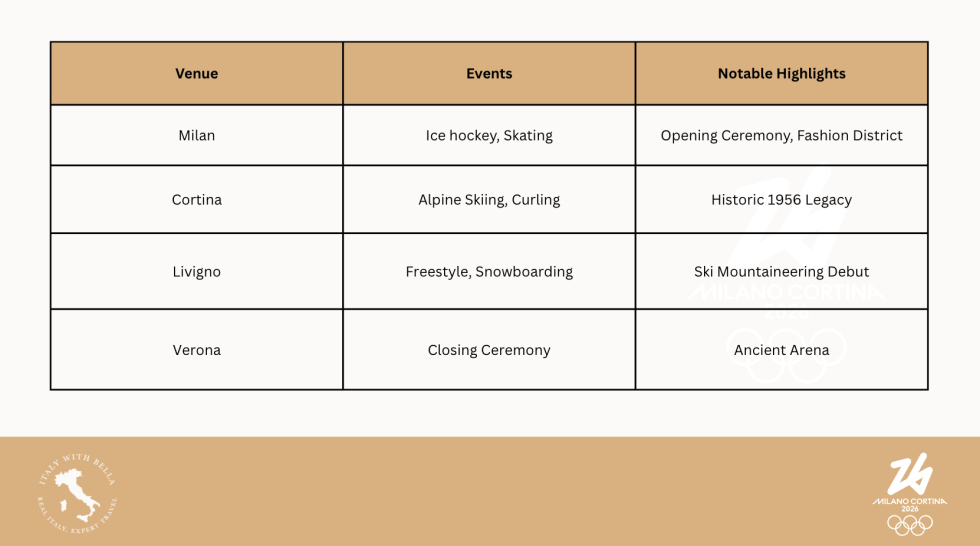
Milan (Lombardy): The cosmopolitan heart of Italy, where style meets sport. Expect the opening ceremony at the iconic San Siro Stadium and thrilling ice hockey and figure skating events.
Cortina d’Ampezzo (Veneto): A jewel of the Dolomites, Cortina is no stranger to Olympic fame — it hosted the Games in 1956. Here, alpine skiing and curling events will take place amidst some of Europe’s most breathtaking mountain scenery.
Val di Fiemme (Trentino-Alto Adige): Famous for Nordic skiing, this valley offers classic Italian alpine charm.
Livigno (Lombardy): Renowned for snowboarding and freestyle skiing, this vibrant mountain town will debut ski mountaineering — a new Olympic sport in 2026.
Verona (Veneto): The romantic city of Romeo and Juliet will host the Closing Ceremony, ensuring the Games end in true Italian style.
Together, these destinations weave a journey through northern Italy’s most captivating landscapes, from Milan’s fashion-forward streets to Cortina’s snow-draped peaks.
Venues & Games Breakdown
Venues & Zones
Rather than being confined to a tight “Olympic Park,” the 2026 Winter Olympics will be spread across five zones in northern Italy.
This decentralized setup adds to the beauty of the experience, but also means that transportation between events requires thoughtful planning. Trains, buses, and shuttles will be available, though expect longer transfer times during peak days
The two official “host cities” are Milan and Cortina d’Ampezzo, but many mountain areas and towns beyond them will host events.
Some key points:
There are 25 event venues planned across the regions.
The hosts are leveraging many existing facilities to limit new construction.
The Games cover terrain from low-elevation (Milan, about 100 m asl) to high mountain passes (Foscagno Pass, ~2,291 m). Milano Cortina 2026
If the sliding track in Cortina is delayed or not ready, a backup plan was considered to host bobsled/luge/skeleton elsewhere (even in Lake Placid, U.S.) NBC Los Angeles+2ArchDaily+2
The organizers emphasize ease of transit and linkage between venues.
Sports & Disciplines
There will be 16 Olympic disciplines (sports) in the Winter Games.
In addition, six Paralympic sports are included in the Paralympic edition.
A highlight: ski mountaineering will make its Olympic debut in 2026.
Regarding medal count: 195 medals will be awarded in the Olympic events.
Because the disciplines will be spread across different mountain clusters, you may see alpine skiing, cross-country, biathlon, ski jumping, nordic combined, snowboarding, freestyling, speed skating, figure skating, ice hockey, curling, skeleton/luge/bobsled (pending venue readiness), etc.
Tickets & Planning Your Visit
Tickets for the 2026 Winter Olympics are digital-only and can be purchased directly through the official ticketing portal. Prices begin around €30, with more than half of all tickets under €100 — making it surprisingly accessible for travelers hoping to attend.
For premium experiences, hospitality packages that include access to VIP lounges, guided services, and exclusive seating are also available.
Because travel and lodging demand will spike early, it’s wise to secure accommodations and event tickets well in advance. Last-minute travel during the Games will be challenging, particularly in mountain towns like Cortina and Livigno, where capacity is limited.
Pro Tip:
Register early for updates and ticketing windows, as many events, especially the alpine skiing finals and the Opening Ceremony, are expected to sell out quickly.
The Legacy of the Winter Olympics in Italy
Italy’s relationship with the Winter Games is rich and storied. Cortina d’Ampezzo first hosted in 1956, marking the country’s debut as a winter host. Fifty years later, Turin 2006 set a new standard for sustainability and style.
Now, Milano Cortina 2026 continues that legacy, emphasizing reuse of existing venues, eco-friendly infrastructure, and respect for the natural alpine environment. It’s not just an event; it’s a model for how tradition and progress can coexist harmoniously.
Getting There: Airports and Access
Italy’s excellent infrastructure makes travel between the Olympic zones straightforward and scenic though travelers should anticipate occasional congestion and winter-weather delays, especially on mountain roads and intercity routes.
Milan Malpensa (MXP): The main international gateway for long-haul travelers.
Milan Linate (LIN): A convenient airport for domestic and European flights.
Venice Marco Polo (VCE): Ideal for reaching Cortina and the Veneto cluster.
Verona Villafranca (VRN): Close to Val di Fiemme and Verona’s ceremony venues.
From these hubs, high-speed trains and well-connected roads link the Olympic sites. Visitors can easily blend city exploration with alpine adventures, imagine beginning your trip with a night at the opera in Milan before heading north into the mountains for downhill skiing and local wine.
Travel, Access & Regions to Stay
Closest Airports & Connections
To reach the Milan / Cortina regions (and the various mountain clusters), here are the principal airports and travel links:
Milan Malpensa Airport (MXP) — the major international gateway for northern Italy.
Milan Linate Airport (LIN) — closer to the city, handling more domestic and regional flights.
Verona Villafranca Airport (VRN) — useful for the eastern side / Veneto direction.
Venice Marco Polo Airport (VCE) — also an option for the Cortina side (Veneto region).
Bolzano Airport (BZO) or Treviso / Treviso Canova (TSF) might be useful for more regional routes depending on final venue assignments.
From these airports, one may transfer via train, bus, or car to the Olympic clusters. The organizers are putting in special transit support and inter-venue transport links.
Transit Between Venues
Because the events are spread across multiple mountain and valley locations:
Expect frequent shuttle buses, regional trains, and mountain transit systems to connect towns to venues.
Some routes will pass alpine passes; weather and mountain road conditions may be a factor. Milano Cortina 2026
It’s wise to choose lodging in one or two “base” towns and use them as launch points for daily travel, rather than trying to stay right next to every event (which could be logistically difficult or costly).
The variation in elevation and terrain means you may shift between lowland (Milan) and high alpine regions — be prepared for altitude, cold, and mountain travel delays.
Recommended Areas to Stay & Base Yourself
Depending on your priorities (massive crowds, convenience to major venues, scenic alpine experience), some suggested bases:
Milan — ideal if you plan to attend the opening / closing ceremonies, indoor events (skating, hockey), and want access to urban comforts.
Cortina d’Ampezzo — iconic alpine resort town, beautiful scenery, close to many mountain events.
Bolzano / South Tyrol / Trentino towns — good “middle ground” lodging near various mountain clusters.
Smaller mountain towns (e.g. Bormio, Livigno, etc.) — if your events are centered around those zones; immersive alpine experience.
Verona — closing ceremony is planned in Verona. Staying nearby may be helpful for the final days.
When booking, try to lock lodging early (especially in mountain towns) because capacity will fill fast, and prices may surge.
Things to Do Beyond the Games
The magic of Milano Cortina 2026 extends far beyond the arenas and slopes. Between events, you’ll find yourself surrounded by art, culture, and the warmth of Italian life.
In Milan
Visit the Duomo di Milano and its rooftop terraces for stunning city views.
See Leonardo da Vinci’s “The Last Supper” – be sure to book tickets months in advance.
Explore the Brera District for galleries and artisan shops.
Take a day trip to Lake Como, where pastel villages and grand villas line the water’s edge.
In the Dolomites
Ride a cable car up to Lagazuoi Mountain for panoramic views.
Indulge in Après-ski in Cortina’s chic wine bars.
Visit nearby Alta Badia for fine dining at altitude — the region boasts several Michelin-starred mountain huts.
Try snowshoeing or a spa day in nearby San Cassiano or Ortisei.

In Verona
Attend a performance in the ancient Arena di Verona (weather permitting).
Sip Amarone wine in the Valpolicella hills.
Stroll Juliet’s balcony and explore the city’s romantic piazzas.
Each location offers a unique way to experience the beauty of Italy in winter — not only as a spectator but as a traveler embracing la dolce vita.
A Journey to Remember
The Milano Cortina 2026 Winter Olympics will be more than a global sporting event — they’ll be a testament to Italy’s enduring charm and its effortless ability to transform moments into memories.
Yes, travel may take a little extra patience, but that’s part of the adventure. Winding roads, mountain passes, and lively crowds are all part of Italy’s warm, bustling rhythm. When experienced with the right mindset, those very challenges become part of the story you’ll tell.
Whether you’re cheering on athletes from a mountain lodge, strolling through Milan’s festive streets, or toasting with prosecco beneath the Dolomites, these Games will remind the world that “La vita è bella” — life is beautiful.