The Origins of Tiramisu: Italy's Most Beloved Dessert
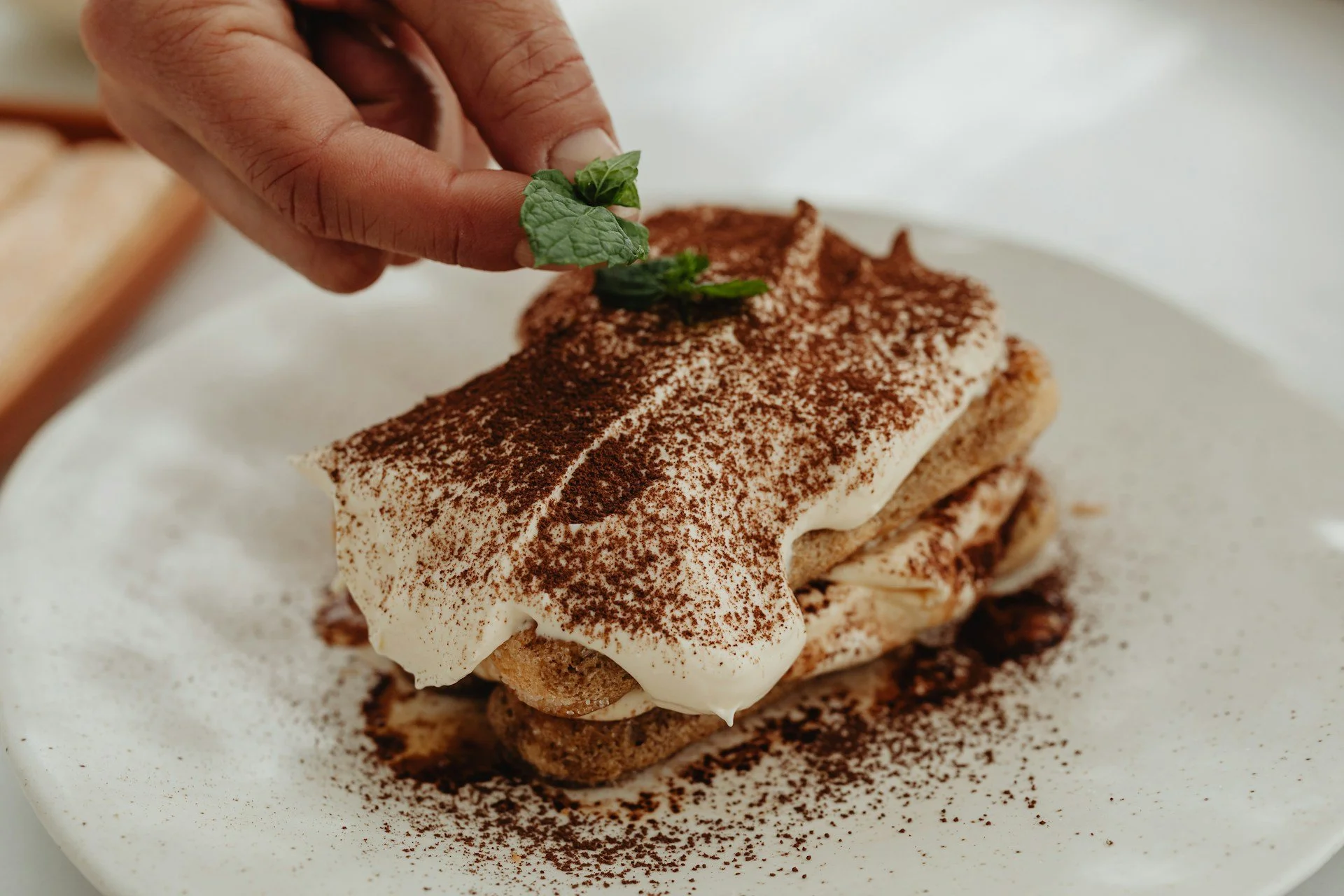
There is a spoon test we swear by. You can learn almost everything you need to know about a restaurant in Italy from the way it makes tiramisu. Is the mascarpone cream light or heavy? Is the coffee bold enough to cut through the sweetness? Did someone dust the cocoa at the last possible second, so it still sits dark and fine on top? A great tiramisu is not complicated. It is a handful of humble ingredients, handled with patience and a little bit of love. And like so many of Italy's best-loved dishes, the story of how it came to be is part history, part legend, and entirely worth telling.
A Dessert Born in Treviso
Most food historians trace tiramisu back to Le Beccherie, a restaurant that has anchored a quiet piazza in Treviso, in the Veneto region, since 1939. The story goes that in the mid-1950s, restaurant owner Alba Campeol had just given birth to her son. Recovering from the exhaustion of childbirth, she was given a restorative family breakfast: egg yolks whipped with sugar, a Treviso tradition called "sbatudin," long used as a natural pick-me-up for new mothers, the elderly, and anyone in need of a boost.
Years later, back in the kitchen at Le Beccherie, Alba and pastry chef Roberto "Loly" Linguanotto revisited that memory. Together they spent months experimenting, folding rich mascarpone into the whipped egg base, soaking ladyfinger cookies in coffee instead of the traditional marsala, and finishing the whole thing with a dusting of bitter cocoa to balance the sweetness. By 1972, the dessert appeared on the Le Beccherie menu under its Treviso dialect name, Tiramesu, meaning "pick me up" or "lift me up." It is a fitting name for a dish invented, at least in one telling, as a way to restore a tired new mother's strength.
The Stories That Compete for the Truth
Ask five Italians where tiramisu really comes from and you may get five different answers, and that is part of what makes this dessert so beloved. Treviso's claim is the most widely accepted, but it is far from the only one.
The Brothel Legend: One well-worn story claims tiramisu was first served at a Treviso pleasure house, meant to give tired customers a jolt of energy before they headed home. Charming or not, there is little hard evidence behind it.
The Friuli Claim: The neighboring Friuli Venezia Giulia region contests Treviso's claim entirely, pointing to a version reportedly served to hikers at an alpine inn in the late 1950s. In 2017, Italy's government recognized tiramisu as a traditional specialty of Friuli as well.
The Coppa Imperiale Theory: Some food historians believe Le Beccherie's version evolved from an earlier goblet dessert called coppa imperiale, created by a different Treviso pastry chef in the early 1960s.
We love that tiramisu does not have one tidy origin story. It has the kind of layered, contested history that so many great Italian dishes carry, passed hand to hand through kitchens and family tables long before anyone thought to write it down.
IWB Tip: If a Veneto itinerary is on your list, we always build in time in Treviso, a slower, less crowded city just thirty minutes from Venice by train, and the kind of place where you can order tiramisu at the source and understand exactly why it became a national treasure.
From a Family Kitchen to the World
What started as a restorative family recipe in a Veneto trattoria is now arguably Italy's most exported dessert. Tiramisu appears on menus from Rome to Palermo, each region and each kitchen putting its own quiet stamp on it. Some chefs lean into more coffee, some soften the sweetness, some add a whisper of marsala or amaretto in homage to the older recipes it grew from. But the bones of the dish stay the same: mascarpone, eggs, sugar, espresso, ladyfingers, and cocoa. Simple ingredients, handled with care, layered with patience.
That, to us, is the real story of tiramisu. Not a single inventor or a single kitchen, but a dish shaped slowly by generations of home cooks and professional pastry chefs alike, each one trying to get the balance just a little more right.
The Italy With Bella Classic Tiramisu
This is the recipe we come back to again and again, the one we make when we want to bring a little bit of Italy home. It stays close to the Treviso original: no shortcuts, no gelatin, no gimmicks. Just cold espresso, good mascarpone, and a light hand with the folding.
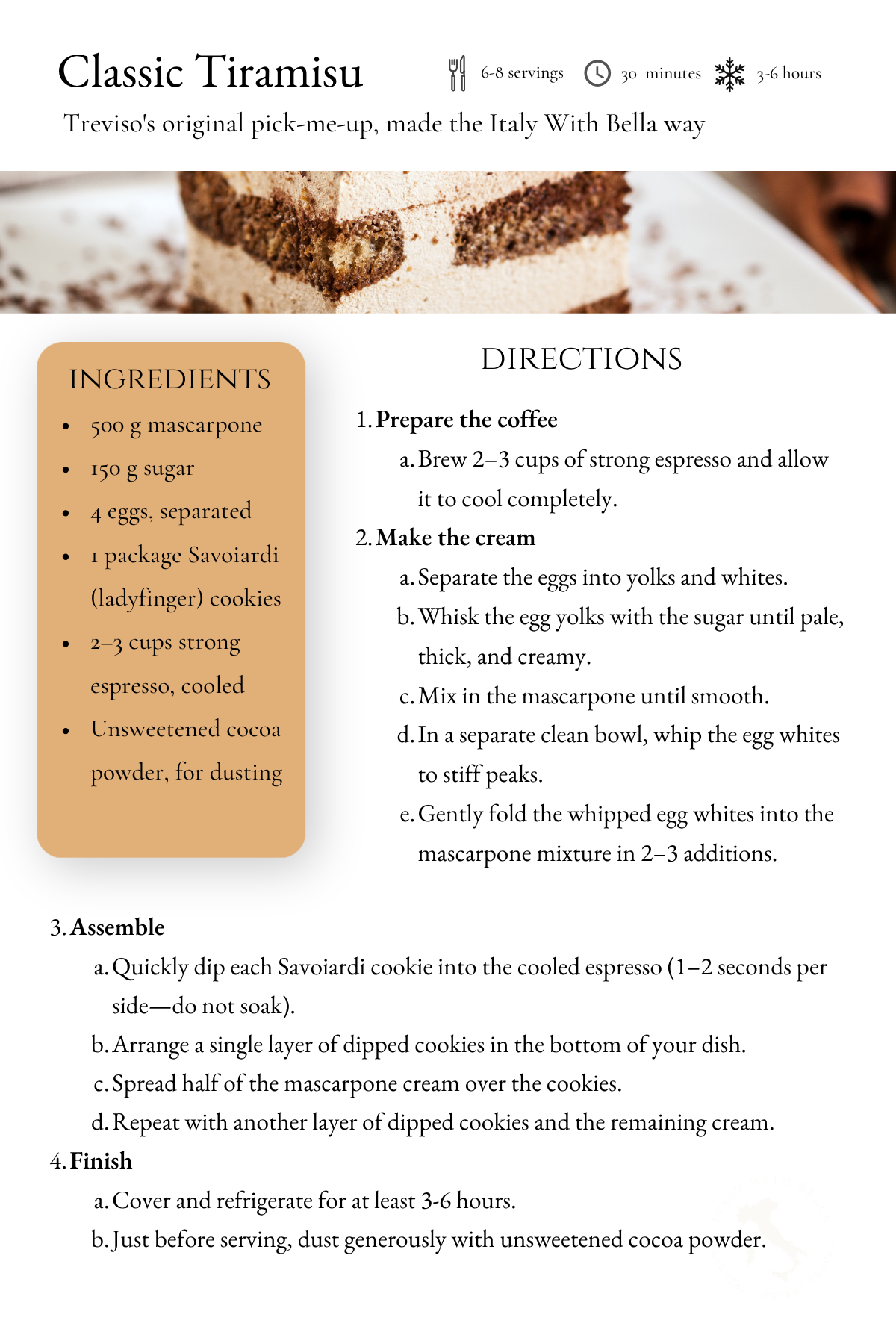
Ingredients
500 g mascarpone
150 g sugar
4 eggs, separated
1 package Savoiardi (ladyfinger) cookies
2–3 cups strong espresso, cooled
Unsweetened cocoa powder, for dusting
Instructions
Prepare the coffee
Brew 2–3 cups of strong espresso and allow it to cool completely.
Make the cream
Separate the eggs into yolks and whites.
Whisk the egg yolks with the sugar until pale, thick, and creamy.
Mix in the mascarpone until smooth.
In a separate clean bowl, whip the egg whites to stiff peaks.
Gently fold the whipped egg whites into the mascarpone mixture in 2–3 additions.
Assemble
Quickly dip each Savoiardi cookie into the cooled espresso, 1–2 seconds per side. Do not soak.
Arrange a single layer of dipped cookies in the bottom of your dish.
Spread half of the mascarpone cream over the cookies.
Repeat with another layer of dipped cookies and the remaining cream.
Finish
Cover and refrigerate for at least 3 to 6 hours.
Just before serving, dust generously with unsweetened cocoa powder.
IWB Tip: Fold, do not stir. The whipped egg whites are what give tiramisu its signature light, almost cloudlike texture. Stirring them in will knock the air out and leave you with a dense, heavy cream.
Download the recipe card here.
Ready to Taste It in Treviso?
Every region of Italy has a dish worth crossing an ocean for, and in Veneto, this is ours. At Italy With Bella, we build fully custom, private itineraries across all 20 Italian regions, including the quieter corners like Treviso that most first-time visitors never see. We have tasted the tiramisu at the source, and we would love to help you do the same.
Start with a free consultation at italywithbella.com/schedule.