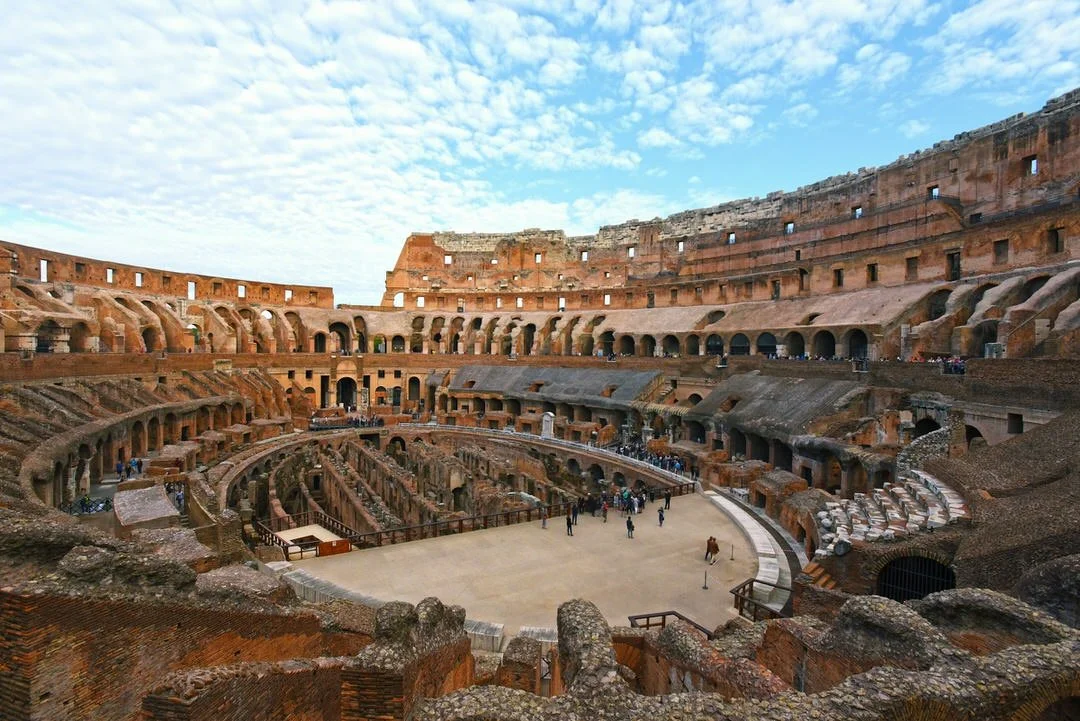
You come up the stairs from the Colosseo metro station, turn your head, and there it is. Nearly two thousand years old, scarred by earthquakes and stone robbers, and still the most recognizable building on earth. The Colosseum in Rome does not ease you in. It simply fills the sky.
It is also one of the most confusing sights in Italy to actually visit. There are multiple ticket types, a booking window that opens and closes in a blink, identity checks at the gate, and a sea of tour sellers outside promising to get you in faster. This guide cuts through all of it, so you know exactly how the Colosseum works and how to experience it the right way.
A Quick History Worth Knowing
Its real name is the Flavian Amphitheatre. Emperor Vespasian began construction around AD 70, and his son Titus inaugurated it in AD 80 with games that, according to ancient writers, lasted 100 days. Under Emperor Domitian, the complex system of tunnels, cages, and lifts beneath the arena floor was completed, allowing animals and fighters to appear in the arena as if from nowhere.
At its height, the Colosseum held an estimated 50,000 spectators, organized by social rank from the senators in the front rows to the common crowd in the upper tiers. For centuries it hosted gladiator combat, wild animal hunts, and public spectacles. After the games ended, it became a fortress, a quarry, and eventually the icon you see today. Knowing this before you go changes what you see: every arch was designed to move tens of thousands of people in and out with an efficiency modern stadiums still study.
How Colosseum Tickets Work
The Colosseum is managed by the Parco Archeologico del Colosseo, and the only official ticketing site is ticketing.colosseo.it. Here is the most important thing to understand: every standard Colosseum ticket also includes the Roman Forum and Palatine Hill. You are not buying a ticket to one building. You are buying a ticket to the heart of ancient Rome, so plan for a full morning or afternoon, not an hour.
Standard 24-Hour Ticket
The basic ticket covers the first and second levels of the Colosseum, plus the Roman Forum and Palatine Hill within 24 hours. At the time of writing, it costs about €18. It is a solid introduction, but it does not include the arena floor, the underground, or the upper tiers.
Full Experience Ticket
The Full Experience ticket is valid for two days and adds one restricted area to your visit. You choose which one when you book:
Arena Floor: Stand where the gladiators stood and look up at the tiers as a fighter would have.
Underground and Arena: Explore the hypogeum, the maze of passages where animals, fighters, and stage machinery waited below the action, then continue onto the arena floor.
Attic (Upper Tiers): Ride a panoramic lift to the highest levels for sweeping views over the arena and the Forum. Not ideal if you are uneasy with heights.
At the time of writing, Full Experience tickets cost about €24. Underground slots are limited to small groups and are always the first to sell out.
What Every Ticket Has in Common
Tickets are nominative. Each ticket carries the visitor’s name, and staff check it against a photo ID at the entrance. Bring your physical passport and make sure the spelling matches exactly.
Entry is timed. You choose a specific time slot and are expected to arrive for it.
Tickets are released 30 days in advance. Popular slots, especially for the underground, can disappear within minutes of release.
Children under 18 enter free, but they still need a reserved ticket.
No backpacks, large bags, or luggage. Security will turn them away, and there is no luggage storage built into your visit.
IWB Tip: Colosseum prices, ticket names, and rules have changed several times in recent years. Everything here reflects the official information available as of November 2026. Always confirm details close to your travel dates.
Why We Always Choose a Private, Skip-the-Line Tour
You can visit the Colosseum on your own. Many people do. But this is one of the places where the way you experience it matters more than almost anywhere else in Italy.
Shared group tours often mean 20 or more strangers, a headset, a guide holding a paddle in the air, and a pace set by the slowest person in the group. You see the Colosseum. You do not feel it. A private guide changes everything. They read your interests, slow down where you want to linger, answer your children’s questions about gladiators, and connect the arena to the Forum and Palatine Hill so the whole story makes sense.
A note on "skip the line," because it is often misunderstood: a reserved, timed ticket lets you bypass the ticket queue, which during peak season can stretch for hours. Every visitor, no matter what they paid, still passes through the same security check. Anyone who promises otherwise is overselling.
When a private Colosseum tour is part of an Italy With Bella itinerary, our trusted tour operators purchase the tickets for you. There is no refreshing a website at midnight 30 days out, no guessing which ticket type to choose. You simply share your names exactly as they appear on your passports, show up at your meeting point, and enjoy it.
IWB Tip: If you are booking on your own, buy only from ticketing.colosseo.it or a licensed tour operator. Several look-alike websites resell tickets at a markup, and the people selling "fast entry" outside the monument are not a shortcut.
Is the Underground Worth It?
For most first-time visitors, yes. The standard levels show you the scale of the Colosseum. The underground shows you how it worked. Walking through the hypogeum, you begin to understand the staging, the noise, the machinery, and the sheer human effort behind every spectacle above. Visits to the underground also include the arena floor, so you get both perspectives in one experience.
If you have visited Rome before, consider the Attic for something new. The view from the upper tiers puts the entire structure, and the surrounding ruins, into context in a way ground level cannot.
The Newest Secret: The Passage of Commodus
In October 2025, after an extensive restoration, the Colosseum opened a once-hidden corridor to the public for the first time. Known as the Passage of Commodus, it is the private underground route Roman emperors used to reach their reserved box without passing through the crowds. The emperor Commodus, famous for his obsession with gladiator games, is said to have survived an assassination attempt in a passage like this one.
Restored stuccoes, frescoes, and marble traces line the walls, and lighting recreates the soft daylight that once filtered in from above. Access is limited to guided visits on select days and times, so it is not something you can simply wander into. Ask your guide whether it can be included on your date.
The Best Time to Visit (And When to Avoid It)
The Colosseum opens at 8:30am every day of the year except December 25 and January 1. Closing times shift with the seasons:
Late March through September: Open until 7:15pm, with last entry at 6:15pm.
Early to late October: Open until 6:30pm, with last entry at 5:30pm.
Late October through February: Open until 4:30pm, with last entry at 3:30pm.
Go early. The first entry slot of the day is the calmest, coolest, and best for photographs. Tuesday through Thursday tend to be quieter than weekends.
Or go late. In spring and autumn, the last slots of the afternoon bring warm, golden light into the arena and thinner crowds as tour groups head off to dinner.
Avoid the first Sunday of the month. Entry is free, which sounds wonderful, but it is walk-in only and the queues can run for hours. Midday in July and August is also challenging. The Forum and Palatine Hill have very little shade.
Do not plan it for your arrival day. After an overnight flight, the Colosseum deserves more than your jet lag. We never schedule major sights on arrival days, and this is the place where that rule matters most.
IWB Tip: Winter is the most underrated season at the Colosseum. Crowds are at their lowest of the year, the low sun is beautiful on the travertine, and you can often move through the arena at your own pace.
What No One Tells You
Bring your physical passport. The name check is real, and a mismatch can mean no entry.
Wear comfortable shoes with grip. Ancient stone is uneven, steps are steep, and the Forum paths are gravel and dust.
Carry a small bag only. Large bags and backpacks are not permitted.
Bring water and a refillable bottle. Rome’s public drinking fountains run fresh, cold water and you will find them throughout the area.
Give yourself three to four hours. The Colosseum itself takes about an hour or more. The Roman Forum and Palatine Hill deserve at least as long.
Skip the costumed "gladiators" outside. Photos with them usually come with a request for payment.
See it from above, too. Walk up to the Parco del Colle Oppio, across from the main entrance, for one of the best free views of the exterior.
Our Honest Take: How to Do This Right
Most people see the Colosseum in a rush, with a generic ticket, in a crowd, and on a day when they are too tired to take it in. They leave with a photo and very little else.
Here is how we would do it. Start with the earliest slot and a private guide. Go below ground first, into the hypogeum, then rise up onto the arena floor and let the scale of it settle in. Afterward, walk the Roman Forum while your guide brings the ruins back to life, and climb the Palatine Hill for the view over the Circus Maximus. Have a long, unhurried lunch in the Monti neighborhood a few minutes away. And end your day the way Romans do, around a table in Trastevere, with a home-cooked dinner and a glass of wine.
The Colosseum is the beginning of Rome’s story, not the whole thing. That is the 99% of Italy most visitors never see, and it is exactly what we are here to help you experience.
Ready to Plan Your Italy Trip?
If the Colosseum is on your list, chances are Italy is calling you in a bigger way. At Italy With Bella, we build fully custom, private itineraries across all 20 Italian regions. We have been to every place we recommend. We know the right time to visit, the right guide to book, and the details that turn a good trip into one you talk about for years.
Start with a free consultation at italywithbella.com/schedule.