What to Expect on an Italy Train Day: A Step-by-Step Survival Guide
Taking the train in Italy is one of the best ways to move between cities, but if you have never done it before, your first train day can feel surprisingly stressful.
Not because trains in Italy are difficult. They are not. In fact, Italy’s train system is one of the most convenient ways to travel between major cities like Rome, Florence, Venice, Milan, Bologna, Naples, and Verona.
The stressful part is usually not the train itself.
It is the station.
It is finding the right track while watching a departure board in another language. It is figuring out where to stand with your suitcase. It is realizing your train’s final destination is not the same as your stop. It is navigating a tight transfer when everyone around you seems to know exactly where they are going.
At Italy With Bella, we have seen again and again that a train day is not just a transportation detail. It is a travel experience that needs to be planned with real life in mind.
That means thinking about luggage, timing, station layout, mobility, crowds, transfers, and the actual human beings taking the trip. A route that looks simple online may feel very different when you are traveling with children, older parents, multiple suitcases, a nervous traveler, or a group where everyone moves at a different pace.
This guide will walk you through how trains work in Italy, what to expect on an Italy train day, and how to handle the most common stress points with more confidence.
First, Know This: Italian Train Travel Has a Rhythm
Train travel in Italy can feel chaotic at first, but there is a rhythm to it.
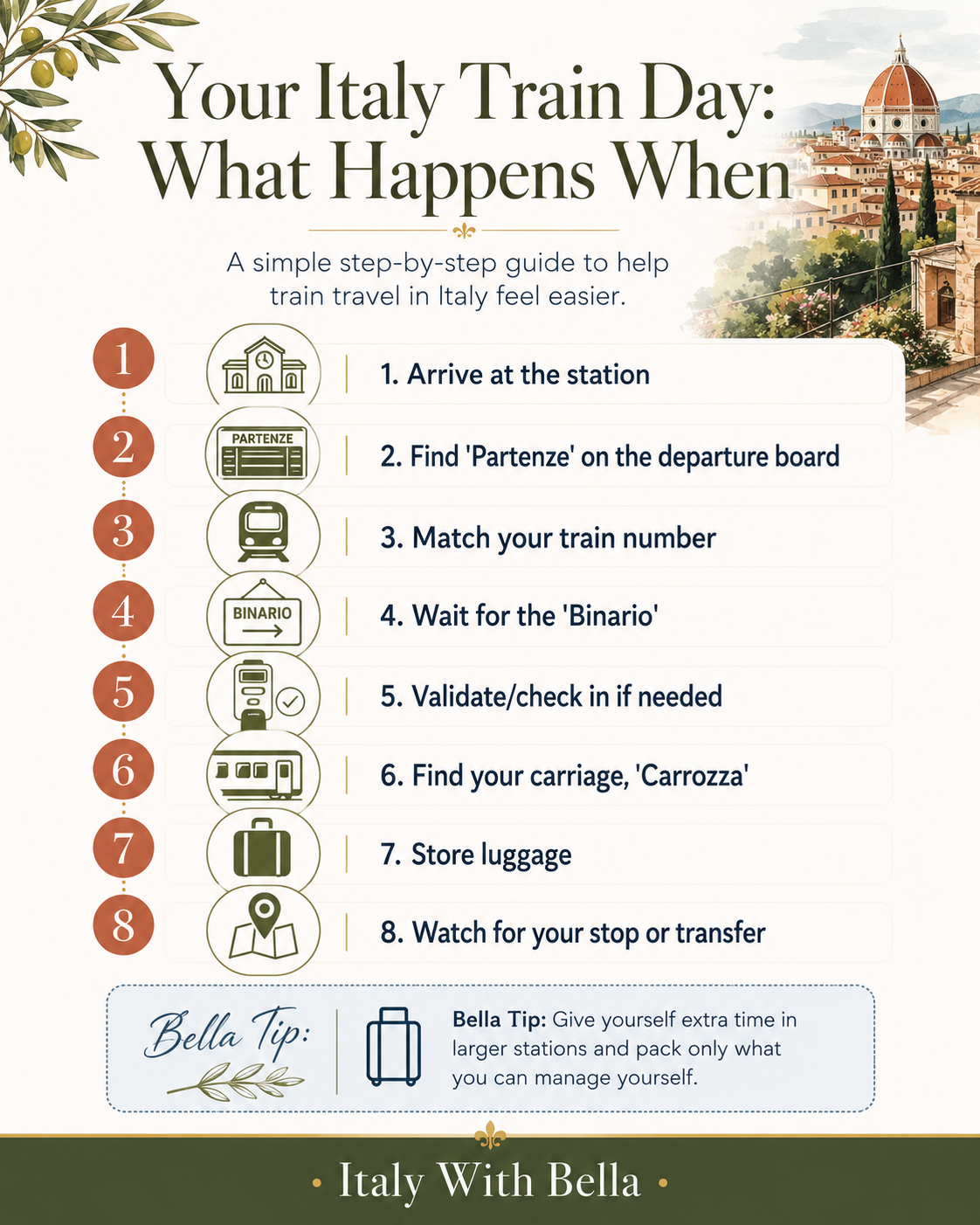
You arrive at the station. You find the departure board. You look for your train number. You wait for the platform, or binario, to appear. You move to the track. You board the correct carriage. You store your luggage. You settle in.
Once you understand the sequence, the process becomes much less intimidating.
The mistake many travelers make is assuming train travel will feel just like air travel or like boarding a train at home. It usually does not. Italian train stations can be busy, fast-moving, and light on hand-holding. You may not see your platform until shortly before departure. Announcements may be in Italian. Staff may be busy. Other travelers may move quickly around you.
None of this means something is wrong.
It simply means you need to know what to watch for.
Step 1: Understand What Type of Train You Are Taking
Before your travel day, look closely at your ticket. Italy has different types of trains, and the experience can vary depending on which one you are taking.
High-speed trains, such as Frecciarossa and Italo, connect major cities and usually include assigned seats. These are often the trains travelers use between Rome and Florence, Florence and Venice, Rome and Naples, or Milan and Bologna. They are faster, more comfortable, and generally easier once you understand the boarding process.
Intercity trains connect cities and towns at a slower pace. Some have assigned seating, and some feel more traditional.
Regional trains are local trains that stop more frequently. These are often used for day trips, smaller towns, or shorter connections. They may not have assigned seats, and they can be more crowded, especially during commuter hours.
This distinction matters because the rules and expectations may be different.
On a high-speed train, you are usually assigned a specific train, carriage, and seat. On a regional train, you may have more flexibility, but you also may need to validate or check in for your ticket before departure.
The more you know before you arrive at the station, the calmer the day will feel.
Step 2: Give Yourself More Time Than the Minimum
This is one of the biggest pieces of advice we give travelers: do not plan train days around the absolute minimum amount of time.
Yes, experienced travelers may be able to arrive at a station and board quickly. But if it is your first time in a major Italian train station, give yourself margin.
For larger stations like Roma Termini, Milano Centrale, Firenze Santa Maria Novella, Napoli Centrale, Bologna Centrale, or Venezia Santa Lucia, plan to arrive with enough time to orient yourself, find the departure board, use the restroom, buy water, and locate your platform without rushing.
This matters even more if you are traveling with larger luggage, children, older relatives, or anyone who needs a slower pace.
A train day can become stressful very quickly when the plan only works if everything goes perfectly. At Italy With Bella, we prefer to build itineraries that allow travelers to breathe. That does not mean wasting hours in train stations. It means allowing realistic time for the way people actually move through the world.
A beautifully planned Italy trip should not depend on sprinting through a station with a suitcase.
Step 3: Go Straight to the Departure Board
When you arrive at the station, look for the departure board.
In Italian, departures are listed as “Partenze.” Arrivals are listed as “Arrivi.” You want “Partenze.”
Now here is the most important part: find your train by train number, not just by destination.
This is where many travelers get confused.
Your ticket may say you are going from Florence to Bologna, but the train’s final destination on the departure board may be Milan. Or you may be going from Rome to Naples, but the board may show Salerno as the final destination.
That does not mean you are in the wrong place.
Italian departure boards often list the final destination of the train, not every stop in large letters. Your stop may be one of several along the route.
So match these details:
Train number
Departure time
Final destination
Platform, or “binario”
“Binario” means platform or track.
Sometimes the binario appears well in advance. Other times, especially at busy stations, it may only appear 10 or 15 minutes before departure. That is normal.
Do not panic if your track is blank at first. Stay near the board, watch carefully, and move once the platform appears.
Step 4: Confirm the Station, Not Just the City
This is one of the details that can make or break a train day.
Many Italian cities have more than one train station.
Rome has Roma Termini and Roma Tiburtina.
Venice has Venezia Santa Lucia and Venezia Mestre.
Milan has Milano Centrale, Milano Porta Garibaldi, and other stations.
Florence has Firenze Santa Maria Novella, Firenze Campo di Marte, and others.
The city name alone is not enough.
You need to know the exact station.
This matters for departures, arrivals, and transfers. A mistake between two stations in the same city can create a stressful situation, especially if you have a timed ticket, luggage, or a tight connection.
This is one of the reasons our team looks carefully at the full travel day when planning an itinerary. We are not just asking, “Can you get from Rome to Florence?” We are asking, “Which station makes the most sense? How are you getting there? How much time do you need? What happens when you arrive? Is this realistic with your luggage and pace?”
The details matter.
Step 5: Validate or Check In When Required
This is one of the most common areas of confusion when learning how trains work in Italy.
Some train tickets are already tied to a specific train, time, and seat. Many high-speed train tickets fall into this category. In that case, you typically board the train and show your ticket when the conductor checks it.
Regional train tickets can be different.
Depending on how you purchased your ticket, you may need to validate a paper ticket at the station or check in digitally before the train departs. This step matters. In some cases, simply purchasing the ticket is not enough.
This is where travelers can accidentally run into trouble. They bought the ticket, but they missed the validation or check-in step.
Before your train day, look carefully at your ticket or app. Watch for words like:
Check-in
Validate
Convalida
Convalidare
If you are unsure, ask someone before boarding. You can show your ticket to station staff and say:
“Devo convalidare?”
This means, “Do I need to validate?”
It is always better to ask before the train leaves than to be confused when the conductor comes through.
Step 6: Find the Right Platform and Keep Watching
Once your binario appears, head toward the platform.
At some stations, the platforms are obvious and close to the main hall. At others, you may need to walk through a long concourse, go downstairs, cross under the tracks, or find a platform in a separate area.
This is another reason margin matters.
At the ticket gates, scan your ticket or show it to the staff member at the entrance. If there are no gates, you may simply walk to the platform.
Even after you find your platform, keep an eye on the screens. Platform changes can happen. They are not constant, but they are possible.
If you feel unsure, ask:
“È questo il treno per Firenze?”
This means, “Is this the train to Florence?”
You can swap in the name of your destination. Even if your Italian is not perfect, the effort plus your ticket usually gets the point across.
Step 7: Board the Correct Carriage
On high-speed trains, your ticket will usually include a carriage number and seat number.
You may see:
Carrozza: carriage
Posto: seat
For example, Carrozza 5, Posto 12A means carriage 5, seat 12A.
The carriage number is usually displayed near the train door. Some platforms also have signs showing where each carriage will stop.
Try to board as close to your carriage as possible. If you board the wrong carriage, you can often walk through the train, but doing that with luggage can be awkward, especially if the aisles are crowded.
Once onboard, find your seat. If someone is sitting there, do not assume the worst. They may simply be in the wrong spot.
A polite “Scusi” and showing your ticket is usually enough.
Step 8: Be Smart About Luggage
Luggage is one of the most important parts of surviving an Italy train day.
The train system itself may be efficient, but you are responsible for your own bags. There is usually no one checking your luggage, lifting it for you, or making sure it gets from one city to the next.
You need to be able to manage what you bring.
This may include lifting your suitcase onto the train, rolling it across uneven platforms, carrying it up or down stairs, placing it in a luggage rack, or maneuvering it through a narrow aisle.
On trains, luggage storage may include:
Overhead racks for smaller bags
Luggage areas near the doors
Open space between seat backs
Designated storage shelves within the carriage
Keep valuables with you in a smaller personal bag. Passports, wallets, phones, medication, cameras, jewelry, and important documents should stay close to your body, not inside a large suitcase stored across the car.
If your larger suitcase is in a luggage area near the doors, stay aware when the train stops and people get on and off. This does not mean you need to feel fearful, but you should be attentive.
Our best advice is simple: pack in a way that matches the trip you are actually taking.
If your itinerary includes multiple train transfers, cobblestone streets, small hotels, stairs, or several city changes, heavy luggage can affect the entire experience. It is not just a packing choice. It is a pacing choice.
Step 9: Expect Crowds Without Letting Them Rattle You
Italian train stations are often crowded. Trains can be crowded too, especially during commuter windows, weekends, holidays, and peak travel months.
Crowded does not mean unsafe by default. Crowded does mean you need to stay aware.
Move out of doorways once you board. Keep your group together without blocking others. Have your ticket ready. Know your carriage and seat before the train arrives. Keep valuables secure. Avoid setting your phone, wallet, or passport down while managing bags.
The most vulnerable moments are often the distracted ones.
When you are rushing, stressed, disoriented, or trying to make a quick decision in a crowd, it is easier to make mistakes. That is why we care so much about pacing and planning. The smoother the travel day, the easier it is to stay present.
If you are traveling with someone who needs extra support, such as an older parent, a traveler with mobility challenges, or someone who becomes anxious in crowds, build the day around that reality.
The goal is not just to “make the train.”
The goal is to move through the day with confidence.
Step 10: Know What to Do During the Ride
Once the train leaves, a conductor may come through to check tickets. Have your paper ticket, app, or QR code ready. You may also be asked for identification, especially if your ticket is tied to your name.
On high-speed trains, announcements are often made in Italian and English. On regional trains, announcements may be harder to hear or only in Italian.
Do not rely only on announcements.
Watch the station names. Use your phone map to follow your route. Set an alarm a few minutes before your arrival if you are nervous about missing your stop.
Before you arrive, gather your belongings. Check the overhead rack, the seat pocket, the floor, and the luggage area. Train stops can be quick, especially on regional routes, so do not wait until the doors open to start getting organized.
A good rhythm is to prepare shortly before your stop, then move toward the doors once the train is close.
Step 11: Handle Italy Train Transfers With Focus
Italy train transfers are very doable, but they require attention.
As soon as you get off your first train, go to the departure board and look for your next train number. Again, do not rely only on destination. Match the train number and departure time.
If your transfer is in a large station, you may need to change platforms using stairs, elevators, escalators, or underground passages. If you have heavy luggage, this can take longer than expected.
This is why we are cautious with tight transfers. Online booking platforms may show a connection as possible, but possible does not always mean pleasant. A short transfer might work beautifully for a solo traveler with a backpack. It may not work well for a family of five with luggage or a couple traveling with older parents.
When planning Italy train transfers, we look at the human side of the itinerary:
How much luggage will you have?
Is this a major station?
Are you changing trains or stations?
Is there enough time if the first train is delayed?
Will this transfer create stress for the rest of the day?
Do you have something scheduled too soon after arrival?
That is the difference between a trip that technically works and a trip that feels good.
If you miss a connection, go to the ticket office or customer service desk. Show your tickets and ask what your options are.
Useful phrase:
“Ho perso la coincidenza.”
This means, “I missed the connection.”
Stay calm, get help, and do not try to solve everything from the middle of a crowded platform.
Step 12: Navigate Language Barriers With Simple Phrases
You do not need to be fluent in Italian to use the trains, but a few words make the experience easier.
Helpful train words:
Partenze: departures
Arrivi: arrivals
Binario: platform or track
Treno: train
Carrozza: carriage
Posto: seat
Biglietto: ticket
Ritardo: delay
Cancellato: cancelled
Uscita: exit
Helpful phrases:
“Dov’è il binario?”
Where is the platform?
“È questo il treno per Roma?”
Is this the train to Rome?
“Devo convalidare?”
Do I need to validate?
“Mi può aiutare?”
Can you help me?
You can also use a translation app and show the screen to a staff member. Keep your question short and specific.
In a busy station, simple is better.
Step 13: Plan the Arrival, Not Just the Departure
A common mistake is focusing only on catching the train and forgetting to plan what happens after arrival.
When you arrive in a new city, you may still need to get to your hotel, meet a driver, walk to a taxi stand, find a vaporetto in Venice, or navigate a busy station with luggage.
Do not schedule something too tight immediately after a train arrival. Give yourself time to get oriented, check in, freshen up, or simply exhale.
This is especially important if the train day includes a transfer, a long ride, or a major city arrival.
At Italy With Bella, we think of the train day as part of the itinerary, not a blank space between “real” experiences. The travel day affects your energy, your mood, and how much you enjoy what comes next.
A well-planned train day can feel smooth and even beautiful. A poorly paced one can make the rest of the day feel rushed before it even begins.
Our Best Italy Train Day Survival Tips
Download your tickets before leaving your hotel.
Keep your phone charged and bring a portable charger.
Match your train by number, not only by destination.
Know your exact departure and arrival stations.
Give yourself extra time in major stations.
Do not overpack if your itinerary includes multiple train days.
Keep valuables in a personal bag that stays with you.
Validate or check in for regional tickets when required.
Watch the departure board until you are on the train.
Avoid extremely tight transfers when traveling with luggage or a group.
Build breathing room into your arrival day.
Ask for help early instead of waiting until you are stressed.
Final Thoughts: A Train Day in Italy Should Not Feel Like a Test
Train travel in Italy can be one of the best parts of your trip. It lets you move from city center to city center, watch the countryside change outside the window, and experience Italy in a way that feels connected to real life.
But it helps to know what you are walking into.
The station may be busy. The platform may appear late. The train may be crowded. Your luggage may feel heavier than it did at home. You may not understand every announcement.
That is all normal.
The key is preparation.
Know your train number. Know your station. Know your platform. Know whether your ticket needs validation. Know how much time you realistically need. Know when to ask for help.
And most importantly, remember that a good Italy itinerary is not just about where you go. It is about how the whole trip feels as you move from place to place.
That is where thoughtful planning makes all the difference.
When the train day is built well, it becomes more than transportation. It becomes a pause between chapters. A quiet ride from Rome to Florence. A glimpse of the countryside on the way to Venice. A moment to sit down, look out the window, and realize you are really here.
Italy is passing by outside the glass.
And now you know exactly how to get where you are going.